




Genome-wide sweeps reshape the gut microbiome
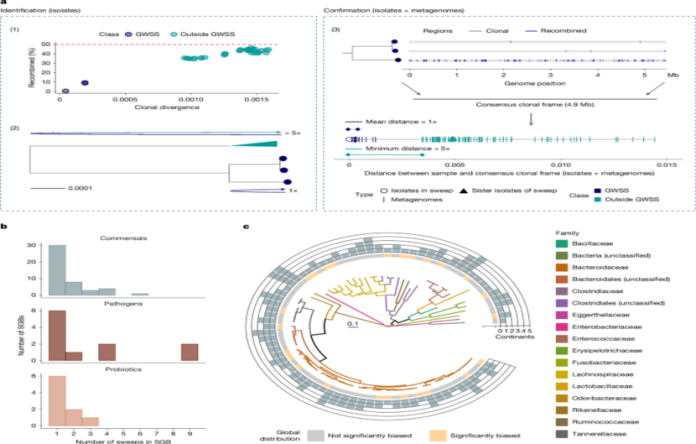
Genome-wide sweeps are reshaping our understanding of the gut microbiome. A 2026 Nature study maps these sweeping changes across thousands of bacterial genomes. The researchers show that clonal and recombined regions create distinct sweep clusters. These clusters span 995 species genome bins, or SGBs, across 66 taxa from 25 bacterial families. In short, genome-wide sweeps reveal how fast bacteria adapt and spread within our gut globally.
How sweep clusters form
To build the map, scientists started with about 20,023 genomes and filtered to 16,864 for analysis. They identified 6,411 high-quality isolates from different people across 995 SGBs. Among these, 176 SGBs had more than five genomes each, and SGB10068, labeled as E. coli, contained 1,053 genomes and was reduced to 25% to balance the dataset.
Using a mix of maximum-likelihood estimates and hidden Markov models, they partitioned genome alignments into clonal and recombined regions. This genome-wide approach yielded fc and 1 – fc values and the recombination rate r/m. They validated the results with HMMs to catch errors, ensuring sweep detection.
Health implications and global reach
Importantly, sweep clusters correlate with host factors. Age, colorectal cancer, inflammatory bowel diseases and type 2 diabetes show associations, indicating ecological differentiation in the gut links to health outcomes. The study gathered data from many populations, showing sweep clusters can spread across continents within decades. This suggests fast microbial evolution plays a larger role in disease risk than previously thought.
Overall, the study offers a practical framework for studying microbiome evolution. It points to future work in diverse populations to better connect microbial ecology with health outcomes. Genome-wide sweeps thus become a key lens on how gut bacteria adapt and affect disease risk.
In sum, genome-wide sweeps illuminate how gut bacteria adapt and spread, shaping microbiome structure and health. This knowledge can guide future personalized microbiome therapies.