




Prime Assembly Sparks New Genome Editing Breakthrough
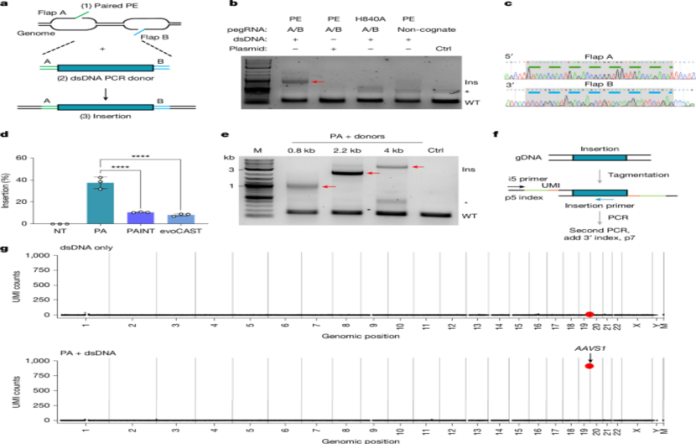
Prime assembly is a new strategy for inserting large DNA fragments into living genomes without cutting both strands at once. In a Nature paper published April 29, 2026, Suzuki and colleagues describe a prime assembly (PA) approach that supports donor fragments from 0.1 kb to 11 kb. The ends of these donors are designed to overlap with flaps produced by twin prime editing (twinPE). The team demonstrated that one or multiple overlapping fragments can join in cells, and using an inhibitor of non-homologous end joining (NHEJ) improved both efficiency and precision. Notably, PA does not require co-delivery of exogenous DNA polymerases and works in non-cycling cells, suggesting it acts independently of canonical HDR pathways. PA proceeds in cells without double-stranded breaks, recombinases, or homology-directed repair, effectively enabling Gibson-like assembly in living systems. These features position Prime assembly as a flexible platform for complex genome edits, expanding the toolkit beyond traditional CRISPR approaches.
By initiating Gibson-like assembly inside cells, PA can generate precise gene insertions without relying on bulky or difficult delivery methods. The approach relies on templates that are easy to produce and do not require specialized enzymes. It shows promise for stacking multiple DNA fragments in a single event, broadening the scale of edits possible in one cell. Combined with twin prime editing, Prime assembly could widen the range of safe, accurate genome modifications.
Why it matters for science and therapy
This advance could accelerate research in functional genomics and open new paths for gene therapies. It also raises questions about delivery, off-target effects, and long-term safety that researchers must answer before clinical use. Researchers will still need to optimize delivery, guard against off‑target edits, and prove safety before clinical use.
In short, Prime assembly strengthens the genome editing toolkit. Pakistan’s labs and researchers can watch this space as the field moves toward practical applications.